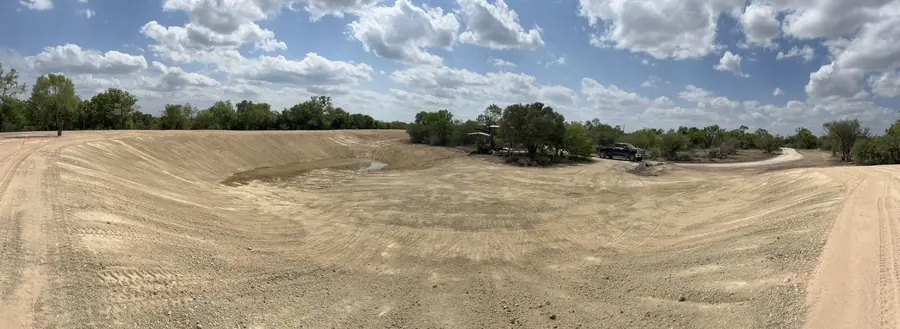
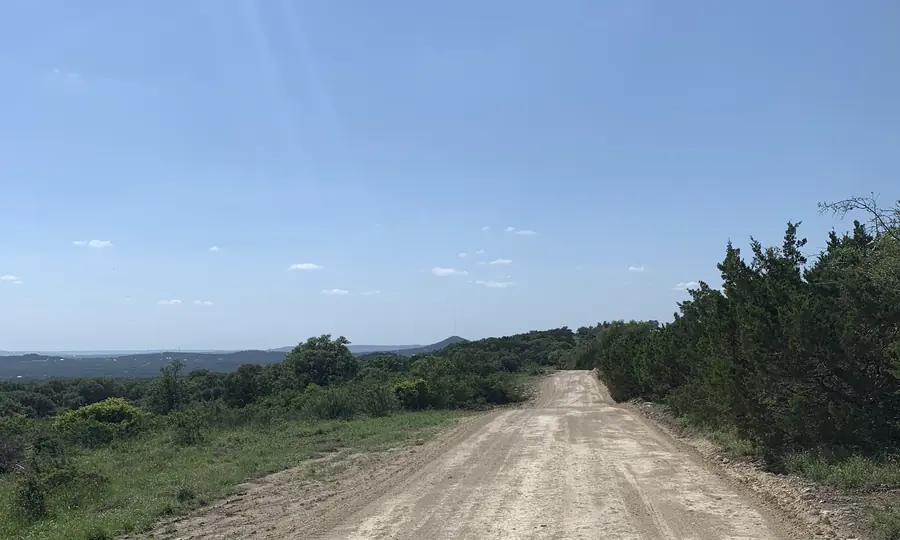
A ranch road lasts when water gets off it fast. Build it on a compacted base, give it a crown so rain sheds to the sides, give that water ditches and turnouts, carry draws under the road in culverts, and harden the creek crossings. Near a floodplain, check with the county first. Never drive into moving water: 12 inches can carry away most cars (National Weather Service).
Why roads wash out
Rain that runs down the middle of a road cuts a rut, the rut becomes a gully, and the gully takes the road. Rain that sits on a road soaks the base and turns it soft. Both start with water that had nowhere better to go.
Build it on a good base
The road bed is cut and shaped, and fill is placed and compacted in layers (lifts) rather than dumped in one pass. A soft base will rut under any surface. See caliche, base or millings for the top layer.
Crown, ditches and turnouts
- Crown. The center of the road sits higher than the edges, so rain sheds sideways instead of running down the wheel tracks.
- Ditches. The water that sheds off needs a channel beside the road.
- Turnouts. On long grades, the ditch water is turned off into the pasture at intervals, before it gathers enough force to cut.
- Grade. Where the land allows, keep the road on the high ground and avoid long straight runs down the fall line.
Culverts
Where the road crosses a draw, a culvert pipe carries the water under it. The pipe has to be sized to the flow it will see in a big storm, set at the right grade, and protected at the ends so the water does not cut around it. A culvert that is too small turns into a dam, and the water goes over the road.
Low-water crossings
Where a creek is too big for a pipe, a low-water crossing is a hardened section of road built to be crossed at normal low flows and to survive being overtopped in a flood. It is not a place to cross when water is running over it.
The National Weather Service is blunt: "a mere 6 inches of fast-moving flood water can knock over an adult", 12 inches of rushing water can carry away most cars, and 2 feet can move SUVs and trucks. Turn around, don't drown (NWS).
Floodplain review
Building in or near a floodplain can need a permit. In Bexar County, Public Works "must review all construction activities conducted on property that is in proximity to the 100-Year Floodplain". The fee is per activity, filed through the county's online portal or at 1948 Probandt St., and an engineer's flood study may be required. Public Works: 210-335-6700 (Bexar County). Other counties have their own rules.
After a flood
The July 4 to 5, 2025 floods showed how fast Hill Country water rises: the Guadalupe came up about 26 feet in 45 minutes at Hunt, about 21 feet in an hour at Kerrville and nearly 27 feet in 45 minutes at Comfort (Wikipedia). Roads and crossings damaged in a flood are worth rebuilding with the drainage rethought, not just patched back the way they were.
Cost-share
Access Road (practice 560) is an NRCS conservation practice (NRCS). If the road is part of a conservation plan on agricultural land, ask your local USDA Service Center about EQIP. See the EQIP guide.
Common questions
How do I stop my caliche road from washing out?
Get the water off it: a crown, ditches, turnouts on long grades, culverts at the draws and hardened crossings at the creeks.
What size culvert do I need?
It depends on how much water the draw carries in a big storm. Too small and the culvert becomes a dam. We look at the draw before choosing a pipe.
Do I need a permit for a low-water crossing?
Near a floodplain, possibly. In Bexar County, Public Works reviews construction near the 100-year floodplain. Check with your county.
Is it safe to drive across a low-water crossing?
Only when no water is running over it. Six inches of fast water can knock over an adult and 12 inches can carry away most cars.
Talk to us about your land
Every piece of land is different. Call (830) 328-3684 or send the form for a free estimate. See our ranch roads service.