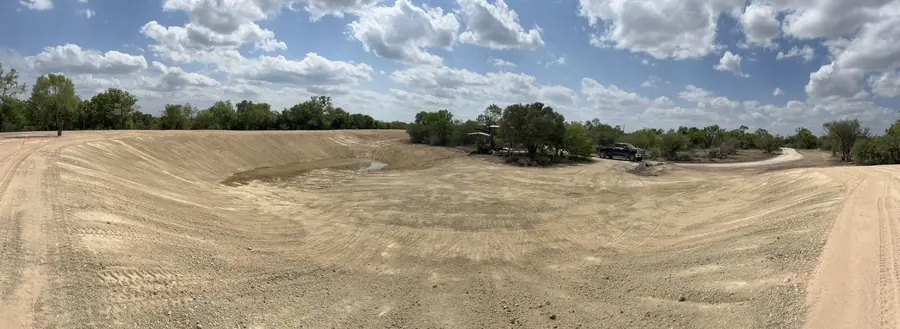

Most leaky tanks leak through the ground under them: limestone crevices, sand or gravel lenses, marl or gypsum, or a berm that was never compacted (NRCS, Texas Extension). The published fixes are compaction, a compacted clay blanket, bentonite, chemical dispersants or a flexible liner, and NRCS has conservation practices for compacted-soil and geomembrane sealing (NRCS).
Leak or just dry weather?
Every tank loses water to the sun. A tank that drops fast after rain, or much faster than other tanks nearby, is more likely leaking. NRCS treats seepage of more than 3 inches a month as a reason to build deeper (NRCS Handbook 590), which gives a sense of what counts as a lot.
Watch where it goes. Wet spots or springs below the berm point to the dam. A tank that drains with no wet spots may be losing water downward.
The usual causes
- Limestone. "Limestone areas are hazardous": hidden crevices or sinks can drain a pond (NRCS). Common on Hill Country ground.
- Coarse soil. Coarse sands and gravels are usually unsuitable for holding water (same source).
- Lenses and pockets. Sand or gravel lenses, marl and gypsum in the basin cause seepage (Soil Considerations in Pond Construction).
- Not enough clay. The Texas Farm Ponds guide calls at least 30 percent clay ideal (Texas Farm Ponds).
- The dam. A berm pushed up without compaction, or without a core trench under it, lets water through (same source).
- Thin tight soil. NRCS wants at least 3 feet of undisturbed tight soil under a reservoir. Dig through it and the seal is gone.
The published fixes
Texas Extension lists these sealing methods (Soil Considerations in Pond Construction):
| Method | How it works | NRCS practice |
|---|---|---|
| Compaction | Soil mixed 8 to 10 inches deep and compacted with a sheep's foot roller | Pond Sealing or Lining, Compacted Soil (520) |
| Clay blanket | A layer of clay spread and compacted over the leaky area | Compacted Soil (520) |
| Bentonite | A clay that "swells greatly when wet", mixed in or spread | None in the codes listed here |
| Chemical dispersants | Treat the soil so its particles pack tighter | None in the codes listed here |
| Flexible membrane | A liner over the basin | Geomembrane (521) |
| Concrete | A hard lining | Concrete (522) |
Which one fits depends on what is causing the leak, how big the tank is and what is available nearby. Most fixes need the tank drained and dry.
Before you fix it
- Find the cause first. A liner over a tank that is leaking through the dam is money wasted.
- Check the size. Above 200 acre-feet, the Texas Farm Ponds guide recommends a professional design.
- Ask about cost-share. NRCS's EQIP program covers practices such as Pond Sealing or Lining. See the EQIP guide.
Does Highlander repair leaky tanks? Not sure if we handle it? Call and ask. For a new tank built to hold from the start, see stock tanks and ponds and building a tank that holds water.
Common questions
Why won't my pond hold water?
Usually because of what is under it: limestone crevices, sand or gravel lenses, marl or gypsum, too little clay, or a dam that was never properly compacted.
Does bentonite fix a leaking pond?
Bentonite is one of the published sealing methods. It swells greatly when wet. Whether it suits your tank depends on the cause and the soil.
Can EQIP help pay to seal a pond?
NRCS has Pond Sealing or Lining practices (Compacted Soil 520, Geomembrane 521, Concrete 522). Ask your local USDA Service Center whether EQIP applies.
Do you fix leaky stock tanks?
Not sure if we handle it? Call and ask.
Talk to us about your land
Every piece of land is different. Call (830) 328-3684 or send the form for a free estimate. See our stock tanks & ponds service.