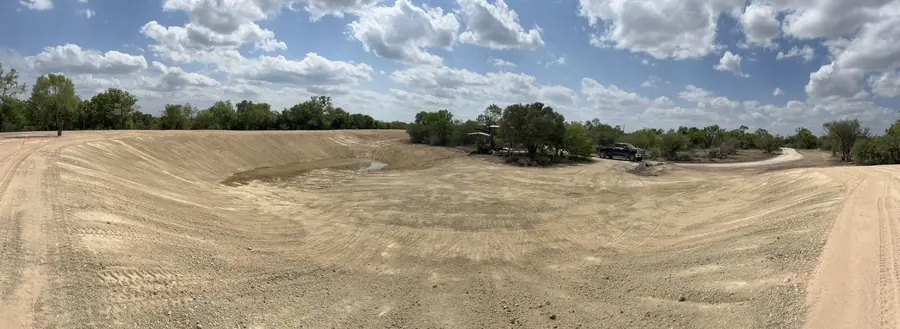

A stock tank holds water when it sits where runoff collects, on at least 3 feet of tight soil with enough clay, with a compacted berm and a deep section for dry years (NRCS, Texas Farm Ponds). Limestone, sand and gravel leak. Test the soil before digging, size the tank to the herd, and remember the 200 acre-foot limit for building without a water-rights permit (Tex. Water Code 11.142).
Stock tank, pond or trough?
In Texas ranch talk a stock tank is an earthen pond: a basin dug where water collects, with the spoil shaped into a berm or dam. Online, "stock tank" also means galvanized troughs and stock tank pools. This guide is about the earthen kind.
Pick the right spot
- Catchment. The tank needs enough land draining into it to fill it, but not so much that floods tear out the berm.
- The berm line. A narrow spot in a draw makes a shorter dam.
- Access. Stock, trucks and you need to reach it after rain. See ranch roads.
- Not on rock. "Limestone areas are hazardous": hidden crevices or sinks can drain a pond (NRCS Handbook 590).
Test the soil first
The NRCS pond handbook sets out what a reservoir site needs (NRCS Handbook 590):
| Test | What the handbook asks for |
|---|---|
| Fine particles | At least 20 percent passing a No. 200 sieve |
| Plasticity | Plasticity index above 10 |
| Thickness | At least 3 feet of undisturbed tight soil |
| Borings | Three or four for each acre where soils are uniform |
| Avoid | Coarse sands and gravels, and limestone areas |
The Texas Farm Ponds guide calls compactable soil with at least 30 percent clay ideal (Texas Farm Ponds). Texas Extension adds that lenses of sand or gravel, marl and gypsum cause seepage (Soil Considerations in Pond Construction). A few test holes before the dig are the cheapest part of a tank.
Size it to the herd and the weather
Start with the animals. NRCS puts beef cattle and horses at 12 to 15 gallons per head per day, and sheep at about 2 (NRCS). Then add for evaporation and seepage.
Depth carries a tank through drought. NRCS says to go deeper where seepage exceeds 3 inches a month or a year-round supply is essential. For South and West Texas the Texas Farm Ponds guide aims for 12 to 16 feet of deep water in part of the pond, with shoreline slopes of at least 2.5 to 1 (Texas Farm Ponds).
For scale: a 2011 Land Report article described a typical tank on one large Texas ranch as about 5,000 cubic yards dug out, around a million gallons, about 14 feet deep and 150 feet across, with 4 to 1 slopes and a clay bottom confirmed by core sample (The Land Report). It is a dated example, but a useful picture.
Medina Lake fell to 2.3 percent of capacity in March 2025 (Wikipedia). Dry years are not rare here. Build for them.
Build it to hold
- A core trench under the dam reduces seepage (Texas Farm Ponds).
- Berm and banks are compacted, not just pushed up.
- Where soil is marginal, the published options are compaction, a compacted clay blanket, bentonite (which "swells greatly when wet"), chemical dispersants, or a flexible liner (Soil Considerations).
- To seal by compaction, Texas Extension describes mixing the soil 8 to 10 inches deep and compacting it with a sheep's foot roller (same source).
Permits and rules
"Without obtaining a permit, a person may construct on the person's own property a dam or reservoir with normal storage of not more than 200 acre-feet of water for domestic and livestock purposes" (Tex. Water Code 11.142). Commercial operations are not covered. Other parts of the section deal with fish and wildlife ponds on qualified open-space land.
- Above 200 acre-feet, get a professional design (Texas Farm Ponds).
- Near a floodplain, check with the county. Bexar County reviews construction near the 100-year floodplain (Bexar County).
- Over the Edwards Aquifer, agricultural activities are excluded from TCEQ's rules except feedlots and concentrated animal feeding operations (30 TAC 213.3).
Fish in the tank
If fishing matters, the Texas Farm Ponds guide says ponds over one surface acre suit bass and bluegill, and those under one acre are best for catfish (Texas Farm Ponds).
Common questions
Will a stock tank hold water on limestone?
It may not. NRCS calls limestone areas hazardous because hidden crevices can drain a pond. Test holes and, where needed, a clay blanket, bentonite or a liner are the answers.
How much clay does a pond need?
The Texas Farm Ponds guide calls compactable soil with at least 30 percent clay ideal. NRCS asks for at least 20 percent fines and a plasticity index above 10.
How deep should a stock tank be?
Deep enough for dry years: the Texas Farm Ponds guide aims for 12 to 16 feet of deep water in part of the pond in South and West Texas.
Do I need a permit to build a stock tank in Texas?
Not a water-rights permit for a domestic and livestock reservoir of up to 200 acre-feet on your own land. Floodplain and local rules can still apply.
Talk to us about your land
Every piece of land is different. Call (830) 328-3684 or send the form for a free estimate. See our stock tanks & ponds service.
Sources
- USDA NRCS, Agriculture Handbook 590: Ponds, Planning, Design, Construction
- Texas Chapter, American Fisheries Society, Texas Farm Ponds
- Texas Agricultural Extension Service, Soil Considerations in Pond Construction
- Texas Water Code 11.142, permit exemptions
- The Land Report, Building a Stock Tank (2011)
- Wikipedia, Lakehills, Texas
- Bexar County Public Works, Floodplain Development Permits
- 30 Texas Administrative Code 213.3, definitions (Cornell LII)